In December 2018, Menke & Associates helped Intervine, a Napa, CA-based wine management company serving the travel industry, with the successful transition to 100% employee ownership. A year later, on the first anniversary of their ESOP, co-founders Colleen May and Michael Borck, who continue to serve as Chairman and Vice Chairman of the Board respectively, reflected on the experience of seeing the company they spent nearly 30 years building being run by its employee-owners.
The story of Intervine’s ESOP began long before a single share was sold. “I had first read about ESOPs maybe 20 years ago,” said May. “That planted the seeds, but we didn’t get where we wanted with our sales for a long time.”
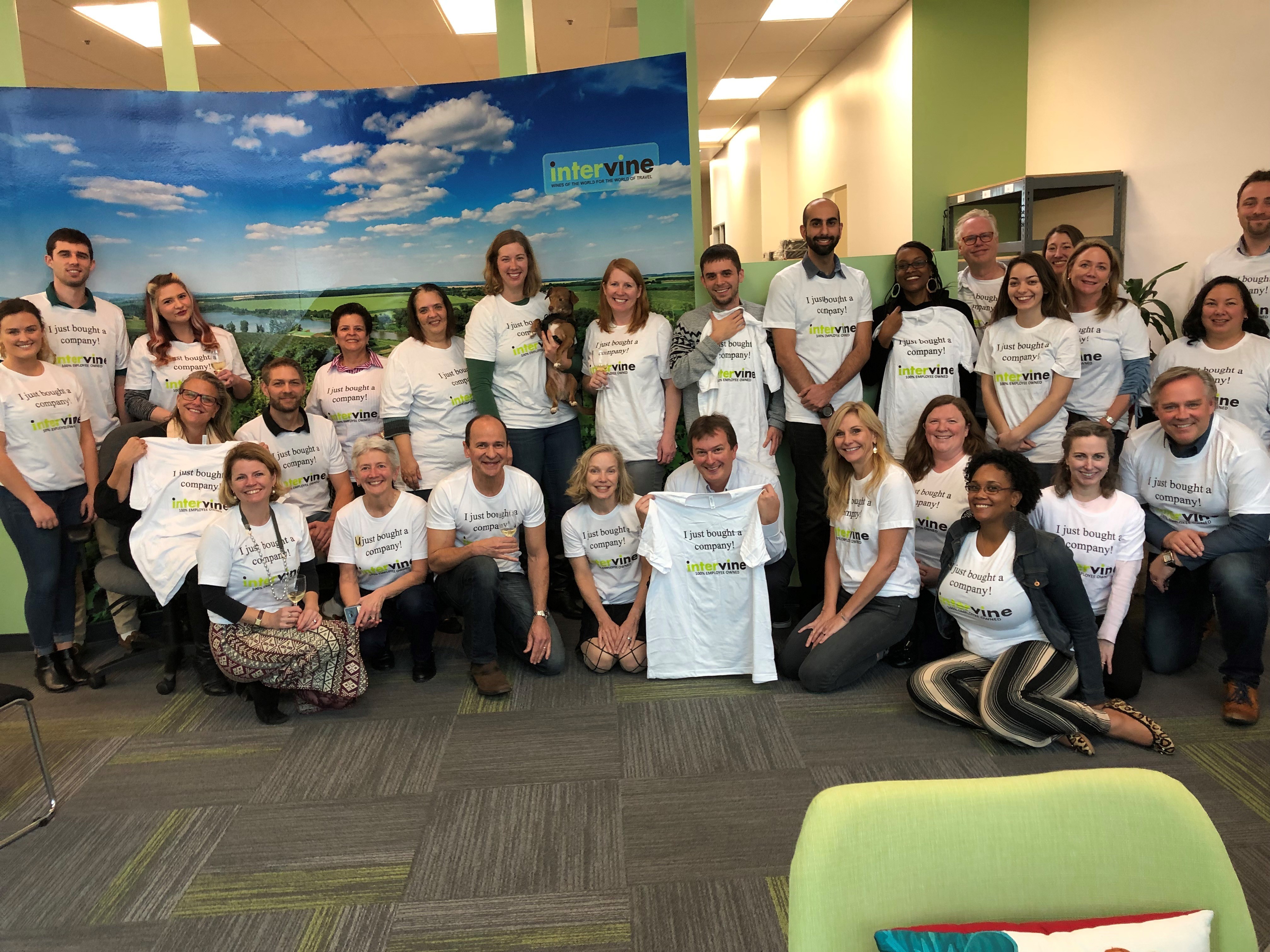
The Employee-Owners of Napa-based Intervine celebrate their first year of having an ESOP
Founded in 1991, Intervine manages the full wine programs of several major airlines, provides extensive wine services to a lengthy list of domestic and international airlines and cruise lines, and is the only company to completely manage the entire wine program of a three-cabin North American airline.
Their services include meticulously sourcing wines from more than 500 wineries around the world, handling all the logistics of getting the right bottles onto the right planes, creating marketing materials for their clients to promote their wine programs, and even training flight and cruise personnel to give them the depth and breadth of knowledge they need to discuss, recommend, and serve wines to an exacting customer base of luxury travelers.
Even with their wide array of services, May and Borck have no illusions about the fact their Intervine is, at its core, a middleman between buyers and sellers. And even in as specialized and rarified an environment as high-end wines, there are always those who will try to cut corners by eliminating the middleman.
“There’s no inherent right for us to exist,” Borck said. “We’ve had pushback from our clients since the day we started. Every day we have to prove who we are and why we exist.” Despite the growth of both Intervine and widespread interest in wine since the 90s, they still feel that pressure to justify themselves amid today’s economic rush to embrace apps and automation. “There’s a huge amount of energy in the world today to push out things in the middle, thinking that will somehow be cheaper. We’re working in an area that’s complex enough that there’s a real need for expertise.”
There is no easily replicable, plug-and-play model for Intervine’s business. In order to consistently deliver service at the high level their clients demand, Intervine needs to maintain a team with a deeply nuanced understanding of wine and its constantly shifting trends; the airline and cruise industries with all their own complexities and changing needs; and the vast array of logistical and legal hurdles involved in getting alcoholic beverages to where they need to go, often requiring moving through multiple international jurisdictions in the process.
Intervine’s business is also deeply driven by the relationships they have built. First class travelers expect perfection. If an airline promises that they serve a particular vintage in their first class cabin, their customers will not accept any excuses for its absence.
“We’re a services company. That’s about people,” said May. “Some of our buyers have been in the industry for nearly 20 years, and they have relationships in France, in Chile, in Germany and Australia. When we say something’s going to be there, it’s there. It’s a very reputational business. So it was really critical for us that we keep our people.”
By 2018, May and Borck were feeling ready to step away from their hands-on leadership roles and all the factors they were looking for had clicked into place. They had a president, Ed Matovcik, who had been doing a tremendous job and was precisely the sort of leader they had in mind to be CEO. They had an employee culture of mutual support, where people already went beyond their specific duties to help their coworkers succeed—a strong foundation for employee ownership. And, with many of the world’s largest airlines and cruise lines as clients, their sales had grown enough to give them a valuation that more than satisfied them both.
With their business so tied to the knowledge and relationships of their team, selling the company to their valued employees through an ESOP simply made sense. They interviewed multiple firms and ultimately chose to work with Menke based on the strength of the recommendation they received from a trusted advisor. From the beginning of the process, they knew they wanted to sell 100% ownership to the ESOP right away.
“For me,” May said, “it was either run the company or send the company on. I saw it as all or nothing, and with the team we had, I felt comfortable for it to be ‘all.’”
In addition to rewarding and retaining their team, May and Borck wanted to ensure that the sale of their shares left their employees and the company in a strong financial position, and they wanted to complete the transaction and have the ESOP in place before the end of their 2018 fiscal year. Menke was able to help them achieve all of those goals.
Menke CEO Kyle Coltman worked closely with Intervine throughout the entire process. Utilizing Menke’s proprietary process of iterative financial modeling, Coltman created over 30 models for the ESOP transaction, empowering May, Borck, and the ESOP’s independent fiduciary to make confident decisions about the terms of the transaction based on up-to-the-minute changes to data.
“Working with Kyle was incredible,” May said. “He was always there to answer questions any time of day, with lightning fast communication. The whole transaction went as successfully as it did because Menke handled it so well.”
When the sale was finalized, Coltman traveled to Intervine’s Napa headquarters for the employee rollout, which was disguised as a brand relaunch. “We introduced him as a marketing consultant. He had a slideshow to introduce our ‘new logo.’ And it said ‘100% employee owned.’ That’s when it started to dawn on people what was really going on.”
May and Borck distributed T-shirts to the employees that read: “I just bought a company.” Coltman stayed to explain the ESOP in detail and answer questions from the employees—now employee-owners.
After the initial shock wore off, May and Borck said that their team leapt into their new roles as owners. “Seeing how little the team has needed from us since the sale has just reinforced our belief that we made the right decision,” said May. “They’ve been really on top of things and started acting like owners without any hesitation.”
“One of the most meaningful things about this whole experience is that we’ve been able to take this company that we put our hearts and souls into and turn it over to people we know and trust, some of whom have been with us for 20 years, and see them rise to the occasion like this,” Borck added.
The employees immediately changed the company’s website and business cards to reflect that Intervine was now a 100% employee-owned company. They also created ESOP committees to continually keep each other informed and involved, ensuring that all 30 employees are not only owners on paper, but that they truly feel the part. They have taken their ownership to heart in a variety of smaller ways, as well.
“I went into the office and saw someone turning out the lights, and they said, ‘Hey, we own the company, we’ve got to save money.’ Where was that when we owned it?” May joked.
With the first year of employee ownership behind them, Intervine is now looking to the future. May and Borck have been focused on building a strong board that would not only serve the ESOP well, but would also pave the way for even greater commercial success. They have already seen the impact that being an employee-owned company has on their client base.
“It’s been a great thing for our customer relationships,” Borck said. “When they hear that the buyer they’re dealing with is now an owner, there’s a genuine desire on the part of the customers to want to help them succeed.”
Intervine’s employee-owners have embraced their ESOP wholeheartedly, and after just a year, they are excitedly looking ahead to what it will mean for the company to completely pay off the ESOP’s acquisition debt.
As May puts it, “Our CFO likes to say, ‘the ESOP’s great—we can’t wait to pay you two off!’”
Menke & Associates, Inc. has helped over 3,500 companies successfully transition to employee ownership. Our holistic ESOP approach enables a positive outcome for the company, its employees and its shareholders. We believe ownership is powerful.

 Phil DeDominicis is an ESOP strategist and M&A advisor who has guided 300+ companies through ESOP formations, financing, and transactions over 20+ years at Menke & Associates. He specializes in selling ESOP‑owned businesses to financial or strategic buyers and in helping ESOP companies acquire other businesses.