October 28, 2026

Pacific Medical Becomes 30% Employee-Owned with Menke Guidance

Tracy, Calif. – October 28, 2026 – Pacific Medical, Inc., powered by Top Shelf Orthopedics, a leading provider of durable medical equipment and orthotic and prosthetic products and services, has completed a transition to 30% employee ownership through the establishment of an Employee Stock Ownership Plan (ESOP). The transaction was guided by Trevor Gilmore, CEO, and Victor Alam, Senior Counsel at Menke, a nationally recognized ESOP advisory firm.

The ESOP transaction supports Pacific Medical’s long-term ownership succession strategy while rewarding employees for their contributions and preserving the company’s independence.Ā 

ā€œIntegrity, innovation and a commitment to excellence have long guided how Pacific Medical serves our patients, partners and one another,ā€ said John Petlansky, President and CEO of Pacific Medical. ā€œOur mission has always been to be a light and leave aĀ  legacy, and becoming an employee-owned company reflects those values and gives us an opportunity to continue to grow that legacy and build the future together.ā€Ā 

ā€œWe have remained committed to a ā€œteam firstā€ mentality as an organization, despite enduring a variety of storms and challenges.Ā  Throughout our formative years, we asked our team, continuously, to trust us and the decisions which we were making. One of our primary goals with the introduction of the ESOP is to demonstrate to our team that their trust and faith has, in fact, been well placed.Ā  Our focus some 40 years later remains unchanged, to create a legacy business that provides unparalleled products and patient care to our referral sources, while concurrently providing growing career opportunities and pathways for everyone at Pacific Medical,ā€ said Jeff Leonard, CFO of Pacific Medical.

The move to employee ownership reinforces Pacific Medical’s commitment to long-term stability for its employees, partners, patients and the communities it serves.

ā€œAn ESOP can be a powerful way for founders to preserve what they’ve built while creating a path for the company to continue serving its customers and communities for years to come,ā€ said Trevor Gilmore, CEO of Menke. ā€œPacific Medical has built a company grounded in integrity, service and excellence, and employee ownership provides an opportunity to carry that legacy forward.ā€Ā 

About Pacific Medical

Founded in 1987 by John Petlansky, Pacific Medical has grown from its roots in eight western states into a nationally recognized leader in the durable medical equipment space. Headquartered in Tracy, California, the company specializes in orthopedic rehabilitation, arthroscopic surgery, sports medicine, prosthetics and orthotics. Through deliberate growth and lasting relationships across the medical community, Pacific Medical now serves healthcare providers and patients in 18 states. Ā 

About Menke

Since its founding in 1974, Menke has enabled more than 4,000 companies to become all or partially employee-owned across the United States. With core competenciesĀ  across the full ESOP lifecycle, Menke is itself an ESOP-owned company, reflecting its firm belief in the power of employee ownership.Ā 

Visit Menke at www.menke.com for more information and a timeline with the history of the company and ESOPs.

Share this article:
LinkedIn
Twitter
Facebook
WhatsApp

Learn why an ESOP is better for You,
your Business, and your Employees

Upcoming Web Seminar

Free 90-Minute Webinar for Business Owners, CFOs & Advisors

Learn how ESOPs fuel growth, reduce taxes, and power succession—without giving up control.

Days
Hours
Minutes
Seconds

Why 2026 is the Time for ESOPs

Strong companies are using ESOPs to play offense. With rates stabilizing and talent still tight, employee ownership is delivering a durable edge:

    • Founder Liquidity—On Your Terms. Create a market for your shares without selling to private equity or competitors.
    • Major Tax Efficiency. Enable capital‑gains deferral for selling shareholders (Section 1042 eligibility) and reduce or even eliminate ongoing corporate income tax for S‑Corporation ESOPs—freeing cash for growth.
    • Talent Magnet. Meaningful employee ownership boosts engagement, retention, and performance—without relying solely on wage increases.
    • Resilient Margins. ESOP tax advantages help counter wage pressure, input costs, and tariffs—so more operating cash flows to strategy.
    • Control & Culture Intact. Transition ownership while keeping leadership and values in place.. Transition ownership while keeping leadership and values in place.

Bottom line: ESOPs create a rare win‑win‑win—for owners, the business, and employees.

What You’ll Learn

ESOP 101—Modern Playbook
How ESOPs work in 2026, who qualifies, deal structures, and timelines.

Tax Strategies that Change the Math
Capital‑gains deferral, corporate tax reduction/elimination for S‑Corp ESOPs, deductible contributions, and cash‑flow modeling.

Talent & Culture
Retention without across‑the‑board raises; ownership communications that actually move the needle.

Protecting Margins
How ESOP incentives can offset cost inflation and support reinvestment.

Valuation & Financing in Today’s Market
Bank/seller notes, mezzanine options, rate considerations, and why ā€œbankable ESOPsā€ are closing now.

Governance & Control
Board, trustee, and management roles—what really changes (and what doesn’t).

Who Should Attend

    • Business OwnersĀ planning an exit, partial sale, or recapitalization

    • CFOsĀ evaluating capital structure and tax strategy

    • Advisors & Succession PlannersĀ guiding owner‑led companies

    • HR & ESOP Committee MembersĀ building engagement around ownership

Agenda (90 Minutes)

    1. Welcome, Speakers & Why ESOPs in 2026Ā (5 min)
      Quick orientation; who Menke is and why ESOPs are winning right now.
    2. ESOP Basics & Business Owner BenefitsĀ (10 min)
      What an ESOP is; liquidity, diversification, succession, productivity.
    3. Myth‑Busting: What ESOPs Do—and Don’t—RequireĀ (5 min)
      No, you don’t have to sell 30%+, borrow big, or give up control.
    4. Deal Structures & Transaction PathsĀ (10 min)
      Cash‑contribution (pay‑as‑you‑go), leveraged (bank/seller notes), and stock contribution; when each fits.
    5. Typical Scenarios & OutcomesĀ (10 min)
      Gradual sales, minority/majority sales, 100% buyouts, and recap strategies.
    6. Who’s a Strong Fit (and Common Constraints)Ā (5 min)
      Profitability, team/transition readiness, industry notes.
    7. Tax Strategy Deep DiveĀ (10 min)
      S‑Corp ESOP distribution savings; C‑Corp §1042 capital‑gains deferral; entity‑path options.
    8. Valuation & Pricing vs. Third‑Party SalesĀ (8 min)
      FMV standards, control vs. minority value, practical comparisons.
    9. Financing the ESOPĀ (8 min)
      Bank market overview, seller paper, balance‑sheet effects, cash‑flow modeling.
    10. Plan Operations & Employee CommunicationsĀ (8 min)
      Eligibility, vesting, distributions, disclosures, and how transparency drives results.
    11. Culture, Engagement & Measured Performance UpliftĀ (6 min)
      What changes on day 2; tying ownership to productivity.
    12. Roadmap & Next StepsĀ (3 min)
      Feasibility, design/adopt, contributions, and timing the sale.
    13. Live Q&AĀ (2 min)

Hear From Past Attendees

ā€œI came in skeptical. I left with a concrete roadmap and the math to brief our board.ā€

ā€œThis clarified our exit plan and showed how we can reward employees at the same time."

Your Presenter: Phil DeDominicis

Phil DeDominicisĀ is an ESOP strategist and M&A advisor who has guided 300+ companies through ESOP formations, financing, and transactions overĀ 20+ years at Menke & Associates. He specializes inĀ selling ESOP‑owned businessesĀ to financial or strategic buyers and inĀ helping ESOP companies acquire other businesses.
Before Menke, Phil spentĀ 14 years in investment banking M&AĀ atĀ Morgan StanleyĀ andĀ Salomon Smith Barney, advising middle‑market companies on change‑of‑control transactions. He holds aĀ B.S. in Chemical EngineeringĀ from theĀ University of DelawareĀ (1985) and anĀ MBA in Finance & AccountingĀ fromĀ UCLA AndersonĀ (1989). Phil currently serves onĀ six for‑profit and not‑for‑profit boards.

What Phil will cover:

    • Where ESOPs win in 2026 (tax, talent, and control)
    • Owner liquidity paths: minority, majority, and 100% sales
    • Financing options and what lenders look for
    • Valuation reality vs. third‑party sales
    • How to prep a board, trustee, and employees for a successful close

Reserve Your Spot Now

Seats are limited.Ā Save yours now and receive the ESOP Feasibility Checklist.

10:00AM – 11:30AM PT
11:00AM – 12:30PM MT
12:00PM – 1:30PM CT
1:00PM – 2:30PM ET

No cost. Suitable for companies with $5M–$500M+ in revenue across construction, manufacturing, services, distribution, tech, and more.

FAQ (Quick Hits)

    • Do I lose control?Ā No—most ESOPs preserve day‑to‑day control with your leadership team and board.

    • Is this only for certain industries?Ā ESOPs work across sectors when cash flow is stable and leadership continuity matters.

    • Can we do a partial sale?Ā Yes—stage liquidity over time while capturing tax benefits.

READY FOR AN ESOP NOW?

Interested in finding out how an ESOP could work for your company?

For a free preliminary analysis, just fill out our ESOP Feasibility Questionnaire.

Related Articles

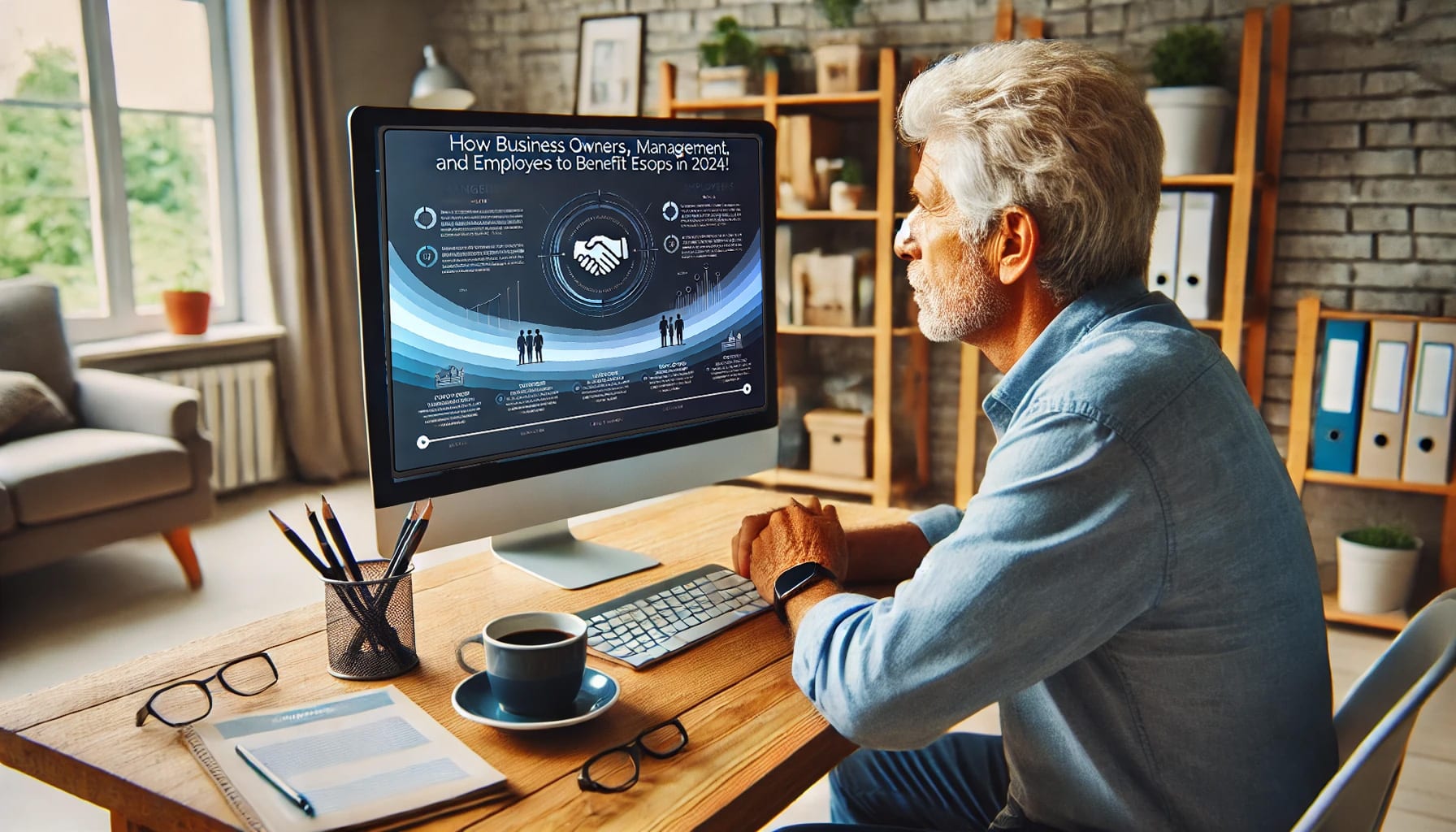
Man viewing employee stock ownership plan presentation on computer screen.
October 21, 2026
Don’t miss this opportunity to discover how ESOPs can align your business goals with the needs of employees and stakeholders.
Menke congratulations graphic announcing Pacific Medical, Inc. is now 30% employee-owned, with the Pacific Medical mountain logo
October 28, 2026
Tracy, Calif.-based Pacific Medical is now 30% employee-owned through a new ESOP that supports its succession strategy and rewards employees.
Glass panels in a stone gallery above a hidden reflected form, representing the ESOP repurchase obligation
October 26, 2026
Most ESOP companies carry a multimillion-dollar commitment that never appears on the balance sheet. Here is what drives the repurchase obligation, how far out to forecast it, and how much cash to set aside before the next large retirement.
Airport concourse ceiling partly finished in wood and metal panels, representing a staged minority ESOP
October 12, 2026
ISEC already had about 450 shareholders when it decided its ownership structure needed to change. Its CEO and CFO explain why they started with a minority ESOP, and why bridging the old plan and the new one has been the hardest part.
Partially completed timber frame on a stone foundation, representing a second stage ESOP transaction to full ownership
September 28, 2026
Your minority ESOP has worked. The debt is paid down and the culture has taken hold. Selling the rest of the company to the ESOP can look like a repeat of the first deal, but valuation, financing, and governance all change once the ESOP takes control.
Brass straightedge on slate, representing consistent ESOP valuation standards under new federal law
September 17, 2026
For fifty years, the hardest question in employee ownership was not how to finance the deal or how to structure the tax benefits. It was what “adequate consideration” actually meant. Congress has now answered it — and the answer is narrower, and more useful, than the headlines suggest.