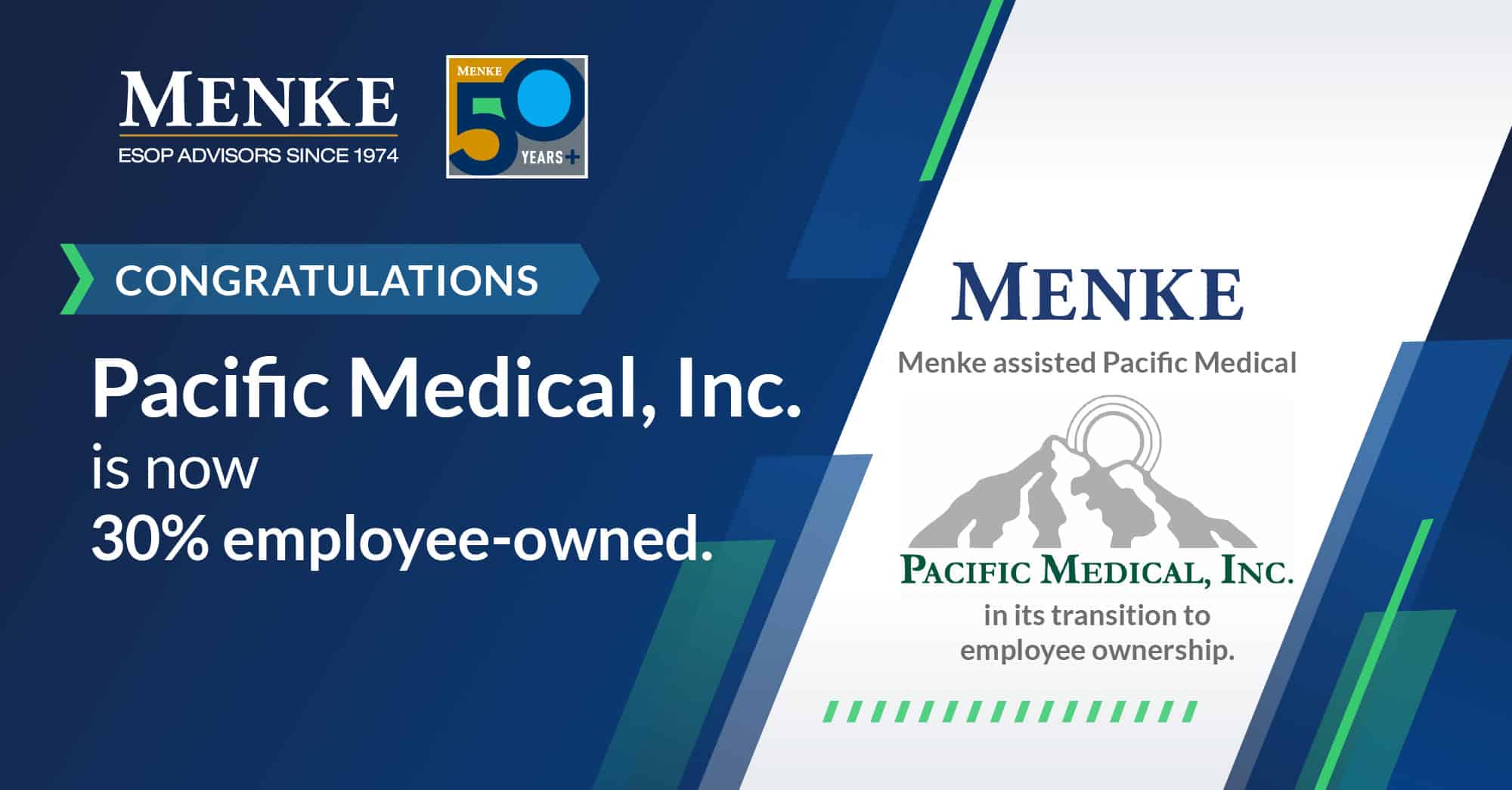
Pacific Medical Becomes 30% Employee-Owned with Menke Guidance
Tracy, Calif.-based Pacific Medical is now 30% employee-owned through a new ESOP that supports its succession strategy and rewards employees.
Tracy, Calif.-based Pacific Medical is now 30% employee-owned through a new ESOP that supports its succession strategy and rewards employees.
Don’t miss this opportunity to discover how ESOPs can align your business goals with the needs of employees and stakeholders.

For fifty years, the hardest question in employee ownership was not how to finance the deal or how to structure the tax benefits. It was what "adequate consideration" actually meant. Congress has now answered it — and the answer is narrower, and more useful, than the headlines suggest.
Two companies can have identical ESOP structures on paper and produce completely different results. The difference usually comes down to three specific things — and most companies get at least one of them wrong.

Halfway through 2026, the ESOP market looks different than it did in January — bank lending is more competitive, private equity firms are eyeing ESOPs as an exit, and legislation is moving. Here's what's actually changed.

ESOP financing has been one of the biggest obstacles for business owners considering employee ownership. In 2026, that's starting to shift, from how banks structure loans to how Washington is treating ESOP oversight.

Fogle Pump & Supply spent six years working toward an ESOP closing, sold 49% to employees while keeping the next generation of family leadership in place, and walked away from the transaction with the business intact. This is what a carefully planned partial ESOP looks like in practice.

Blach Construction, a California-based commercial general contractor, has completed a transition to 30% employee ownership through a new ESOP, with guidance from Menke.

Recent developments in Washington, D.C. and the lending marketplace point to growing momentum for employee ownership. From proposed legislation and regulatory support to increased bank participation, ESOPs continue to strengthen as a succession planning and wealth-building strategy.

New Rutgers research shows measurable productivity gains tied to employee ownership. Trevor Gilmore and Ben Spadt explain what the data means for ESOP companies and business owners considering succession options.

Jeremy Ames, CEO of Guidant Financial, joins ESOP Radio to discuss how entrepreneurs use retirement funds to launch businesses through ROBS strategies and why ownership fundamentally changes behavior.

The Department of Labor’s latest guidance signals a decisive shift in EBSA enforcement priorities. For ESOP companies, this means a move away from unpredictable, litigation-driven oversight toward a more transparent, principles-based framework grounded in fiduciary law.

A Bay Area urban planning firm shares how early planning, ESOP pre-funding, and consistent employee communication helped create a smoother ownership transition.

ESOPs are becoming a key strategy for attracting and retaining talent, with companies using employee ownership to build stronger cultures and long-term success.

A data-driven look at why ESOP companies in the AEC industry are commanding higher valuations. This episode breaks down the key drivers—backlog, tax efficiency, EBITDA multiples, and risk—that influence long-term value.

From a $2,000 startup to employee ownership, this founder shares what really changes after an ESOP—covering leadership, governance, and long-term strategy.

Discover how ESOPs help Central Valley companies attract talent, boost performance, and plan succession through employee ownership.

An ESOP creates ownership.But ownership alone does not guarantee alignment. In Episode 15 of ESOP Radio, we explore how EOS (Entrepreneurial Operating System) strengthens employee-owned companies by creating clarity, accountability, and disciplined execution. Why EOS Matters in an ESOP Company Employee ownership creates long-term alignment between employees and company value. EOS creates: Clear leadership accountability…

The Great Ownership Transfer could shift $5T in small business value, impacting jobs, wealth, and economic mobility across the U.S.

Discover the top 10 ESOP predictions for 2026, from AI-driven owner awareness to private equity exits, bank lending growth, and rising demand.

In January 2026, the U.S. Department of Labor released its long-awaited Employee Ownership Initiative Report to Congress, fulfilling its mandate under the WORK provisions of SECURE 2.0. Unlike prior federal commentary on employee ownership, this report does more than celebrate ESOP growth. It formally establishes a new institutional framework inside the Department of Labor —…

Legacy Utility CEO shares why he chose an ESOP over private equity, pairing EOS with employee ownership to drive long-term growth and alignment.

Brown Construction CEO Ron Brown shares why he chose a 100% ESOP over a third-party sale and what the decision meant for succession, culture, and long-term independence.

Trevor Gilmore and Ben Spadt walk through the ten critical questions business owners should ask before deciding whether an ESOP is the right succession and ownership strategy.

On January 15, 2026, the U.S. Department of Labor’s Employee Benefits Security Administration (EBSA) quietly did something the ESOP community has been asking for—loudly—for years. It changed course. In a major overhaul of its national enforcement projects for fiscal year 2026, EBSA removed Employee Stock Ownership Plans (ESOPs) from its list of national enforcement priorities.…

In a powerful bipartisan moment for worker-ownership advocates, the U.S. Senate Health, Education, Labor & Pensions (HELP) Committee voted unanimously on July 31 to advance two major bills promoting and protecting Employee Stock Ownership Plans (ESOPs): the Retire Through Ownership Act (S. 2403) and the Employee Ownership Representation Act (S. 1728). Together, these bills represent…

Update (July 31, 2025): The Senate HELP Committee has now unanimously passed the ESOP bills discussed in this hearing. [Read the follow-up here →] On July 24, 2025, the Senate Committee on Health, Education, Labor, and Pensions (HELP) convened a powerful and bipartisan hearing under the banner: “Empowering Workers by Expanding Employee Ownership.” With support…

And the Senate Follows Up With a Powerful Push to Expand Employee Ownership Washington, D.C. – July 22, 2025 This week marked a historic moment for the employee ownership movement. On Tuesday, the House Education and Workforce Committee held a hard-hitting oversight hearing scrutinizing the Department of Labor’s Employee Benefits Security Administration (EBSA) for what…

Patricia Hetter Kelso (nee Bertsche), pioneering champion of democratic capitalism, died peacefully in her San Francisco home on Independence Day, July 4, 2025, at age 98. Born in Anderson, Indiana, Patricia dedicated her life to the development and advancement of Binary Economics, a revolutionary economic theory that aims to achieve universal capitalism. After earning degrees…

On June 11, 2025, Oregon made history for employee ownership. Governor Tina Kotek signed House Bill 3646 into law, creating a formal preference in public procurement for companies that are majority-owned by their employees—either directly or through an Employee Stock Ownership Plan (ESOP). Starting in 2026, Oregon state agencies will be able to give these…