January 15, 2026

EBSA Ends the “War on ESOPs”

On January 15, 2026, the U.S. Department of Labor’s Employee Benefits Security Administration (EBSA) quietly did something the ESOP community has been asking for—loudly—for years.

It changed course.

In a major overhaul of its national enforcement projects for fiscal year 2026, EBSA removed Employee Stock Ownership Plans (ESOPs) from its list of national enforcement priorities. For companies, trustees, lenders, and—most importantly—employee-owners, this is not a footnote. It’s a signal.

After years of aggressive, often opaque enforcement tactics aimed squarely at ESOPs, the agency appears to be stepping back from what many have described as a regulatory “war” on employee ownership.

What EBSA Announced—and What It Didn’t

EBSA’s new enforcement framework refocuses agency resources on areas where misconduct is both more prevalent and more harmful to participants, including:

    • Cybersecurity breaches
    • Barriers to mental health and substance use disorder benefits
    • Improper benefit distributions
    • Retirement asset mismanagement
    • Surprise medical billing
    • Criminal abuse of contributory benefit plans

Notably absent from that list: ESOPs.

EBSA also announced it will scale back its focus on missing participants, citing the launch of the Retirement Savings Lost and Found Database—another sign the agency is prioritizing efficiency and outcomes over volume-driven investigations.

Deputy Secretary of Labor Keith Sonderling summed up the shift succinctly:

“By recalibrating the areas our investigators focus on, EBSA investigations will be more efficient, responsive, and prioritize serious misconduct rather than minor foot faults.”

For ESOP sponsors who have spent years navigating investigations over valuation minutiae, hindsight critiques, and unwritten enforcement standards, that statement lands differently than it might have a few years ago.

Context Matters: This Didn’t Happen in a Vacuum

This policy change follows intense bipartisan scrutiny from Congress.

As we previously wrote in Congress to DOL: It’s Time to Shine a Light on EBSA’s Anti-ESOP Tactics, the summer of 2025 marked a turning point:

    • The House Education and Workforce Committee held a high-profile oversight hearing examining EBSA’s investigation practices, including years-long probes, litigation-by-enforcement, and undisclosed coordination with plaintiff firms.
    • The Senate HELP Committee followed with a hearing focused on expanding employee ownership, reinforcing Congress’s intent that ESOPs should be encouraged—not chilled—by regulators.

At those hearings, leaders from The ESOP Association made clear that EBSA’s approach was:

    • Discouraging new ESOP formations
    • Draining company resources through prolonged investigations
    • Undermining decades of bipartisan federal policy supporting employee ownership

Congress didn’t just complain—it proposed solutions. Transparency bills. Representation on the ERISA Advisory Council. Statutory clarity on valuation standards.

Against that backdrop, EBSA’s decision to remove ESOPs from its national enforcement project list looks far less coincidental.

Why This Is a Big Deal for ESOP Companies

Let’s be clear: ESOPs are still governed by ERISA. Fiduciary duties still apply. Fair market value still matters. Bad actors should expect scrutiny.

But the practical impact of this shift is significant.

Removing ESOPs as a national enforcement priority means:

    • Fewer “initiative-driven” investigations launched simply because a company has an ESOP
    • More discretion for investigators to focus on actual red flags, not structural features of employee ownership
    • Reduced risk of regulatory second-guessing based on evolving, unwritten standards
    • A healthier environment for ESOP financing, transactions, and long-term planning

In short, ESOPs are no longer being treated as presumptively suspect.

That matters for closely held businesses considering succession options. It matters for lenders underwriting ESOP transactions. And it matters for employees whose retirement security is tied directly to company performance.

A Shift Toward Balance—and Accountability

Assistant Secretary for Employee Benefits Security Daniel Aronowitz emphasized that EBSA is committed to timely, fair investigations that produce real results for participants.

That language—timely, fair, results-driven—is exactly what the ESOP community has been asking for.

This announcement does not erase the past. But it does suggest that EBSA has heard the message coming from Congress, employers, and employee-owners alike:

Employee ownership is not a loophole. It is a policy choice.

And it’s one that enjoys rare, durable bipartisan support.

What This Means If You’re Considering an ESOP in 2026


Practical Takeaways for Business Owners and ESOP Fiduciaries

If you’re a closely held company owner, board member, or management team evaluating an ESOP—either as a new transaction or as an existing structure—this EBSA shift materially changes the risk calculus.

    1. Regulatory Risk Is More Predictable
      With ESOPs no longer singled out as a national enforcement priority, companies can expect fewer initiative-driven investigations and less regulatory second-guessing based on hindsight or unwritten standards. That doesn’t eliminate fiduciary risk—but it does reduce uncertainty.
    2. Financing and Deal Execution Should Improve
      Lenders, trustees, and transaction advisors pay close attention to enforcement trends. A less adversarial EBSA posture supports smoother underwriting, more consistent trustee decision-making, and fewer transactions stalled by fear of regulatory exposure.
    3. Valuation Still Matters—But the Goalposts Are Stabilizing
      Independent valuations, prudent process, and good documentation remain essential. The difference now is that EBSA appears less inclined to regulate valuation theory through enforcement actions rather than formal guidance.
    4. Timing Matters
      For owners who delayed ESOP succession due to regulatory headwinds, 2026 may represent a window of opportunity. Policy momentum, Congressional support, and agency recalibration are finally aligned.

Bottom line: ESOPs were never meant to be treated as suspect by default. With EBSA stepping back, employee ownership is again being evaluated on its merits—not its structure.

What Comes Next

The end of the “war on ESOPs” doesn’t mean the work is done.

Legislation pending in Congress would:

    • Increase transparency around EBSA investigations
    • Restore balance between regulators and regulated plans
    • Give ESOPs a formal voice in ERISA policymaking
    • Clarify valuation standards to reduce enforcement-by-litigation

Momentum is clearly shifting—but continued advocacy matters.

For now, though, this much is true:

January 15, 2026 marks a meaningful turning point.

EBSA has recalibrated. ESOPs are no longer in the crosshairs. And employee ownership is one step closer to the stable, predictable regulatory environment it deserves.

Stay tuned. The next chapter for ESOPs is being written in real time.

Share this article:
LinkedIn
Twitter
Facebook
WhatsApp

Learn why an ESOP is better for You,
your Business, and your Employees

Upcoming Web Seminar

Free 90-Minute Webinar for Business Owners, CFOs & Advisors

Learn how ESOPs fuel growth, reduce taxes, and power succession—without giving up control.

Days
Hours
Minutes
Seconds

Why 2026 is the Time for ESOPs

Strong companies are using ESOPs to play offense. With rates stabilizing and talent still tight, employee ownership is delivering a durable edge:

    • Founder Liquidity—On Your Terms. Create a market for your shares without selling to private equity or competitors.
    • Major Tax Efficiency. Enable capital‑gains deferral for selling shareholders (Section 1042 eligibility) and reduce or even eliminate ongoing corporate income tax for S‑Corporation ESOPs—freeing cash for growth.
    • Talent Magnet. Meaningful employee ownership boosts engagement, retention, and performance—without relying solely on wage increases.
    • Resilient Margins. ESOP tax advantages help counter wage pressure, input costs, and tariffs—so more operating cash flows to strategy.
    • Control & Culture Intact. Transition ownership while keeping leadership and values in place.. Transition ownership while keeping leadership and values in place.

Bottom line: ESOPs create a rare win‑win‑win—for owners, the business, and employees.

What You’ll Learn

ESOP 101—Modern Playbook
How ESOPs work in 2026, who qualifies, deal structures, and timelines.

Tax Strategies that Change the Math
Capital‑gains deferral, corporate tax reduction/elimination for S‑Corp ESOPs, deductible contributions, and cash‑flow modeling.

Talent & Culture
Retention without across‑the‑board raises; ownership communications that actually move the needle.

Protecting Margins
How ESOP incentives can offset cost inflation and support reinvestment.

Valuation & Financing in Today’s Market
Bank/seller notes, mezzanine options, rate considerations, and why “bankable ESOPs” are closing now.

Governance & Control
Board, trustee, and management roles—what really changes (and what doesn’t).

Who Should Attend

    • Business Owners planning an exit, partial sale, or recapitalization

    • CFOs evaluating capital structure and tax strategy

    • Advisors & Succession Planners guiding owner‑led companies

    • HR & ESOP Committee Members building engagement around ownership

Agenda (90 Minutes)

    1. Welcome, Speakers & Why ESOPs in 2026 (5 min)
      Quick orientation; who Menke is and why ESOPs are winning right now.
    2. ESOP Basics & Business Owner Benefits (10 min)
      What an ESOP is; liquidity, diversification, succession, productivity.
    3. Myth‑Busting: What ESOPs Do—and Don’t—Require (5 min)
      No, you don’t have to sell 30%+, borrow big, or give up control.
    4. Deal Structures & Transaction Paths (10 min)
      Cash‑contribution (pay‑as‑you‑go), leveraged (bank/seller notes), and stock contribution; when each fits.
    5. Typical Scenarios & Outcomes (10 min)
      Gradual sales, minority/majority sales, 100% buyouts, and recap strategies.
    6. Who’s a Strong Fit (and Common Constraints) (5 min)
      Profitability, team/transition readiness, industry notes.
    7. Tax Strategy Deep Dive (10 min)
      S‑Corp ESOP distribution savings; C‑Corp §1042 capital‑gains deferral; entity‑path options.
    8. Valuation & Pricing vs. Third‑Party Sales (8 min)
      FMV standards, control vs. minority value, practical comparisons.
    9. Financing the ESOP (8 min)
      Bank market overview, seller paper, balance‑sheet effects, cash‑flow modeling.
    10. Plan Operations & Employee Communications (8 min)
      Eligibility, vesting, distributions, disclosures, and how transparency drives results.
    11. Culture, Engagement & Measured Performance Uplift (6 min)
      What changes on day 2; tying ownership to productivity.
    12. Roadmap & Next Steps (3 min)
      Feasibility, design/adopt, contributions, and timing the sale.
    13. Live Q&A (2 min)

Hear From Past Attendees

“I came in skeptical. I left with a concrete roadmap and the math to brief our board.”

“This clarified our exit plan and showed how we can reward employees at the same time."

Your Presenter: Phil DeDominicis

Phil DeDominicis is an ESOP strategist and M&A advisor who has guided 300+ companies through ESOP formations, financing, and transactions over 20+ years at Menke & Associates. He specializes in selling ESOP‑owned businesses to financial or strategic buyers and in helping ESOP companies acquire other businesses.
Before Menke, Phil spent 14 years in investment banking M&A at Morgan Stanley and Salomon Smith Barney, advising middle‑market companies on change‑of‑control transactions. He holds a B.S. in Chemical Engineering from the University of Delaware (1985) and an MBA in Finance & Accounting from UCLA Anderson (1989). Phil currently serves on six for‑profit and not‑for‑profit boards.

What Phil will cover:

    • Where ESOPs win in 2026 (tax, talent, and control)
    • Owner liquidity paths: minority, majority, and 100% sales
    • Financing options and what lenders look for
    • Valuation reality vs. third‑party sales
    • How to prep a board, trustee, and employees for a successful close

Reserve Your Spot Now

Seats are limited. Save yours now and receive the ESOP Feasibility Checklist.

10:00AM – 11:30AM PT
11:00AM – 12:30PM MT
12:00PM – 1:30PM CT
1:00PM – 2:30PM ET

No cost. Suitable for companies with $5M–$500M+ in revenue across construction, manufacturing, services, distribution, tech, and more.

FAQ (Quick Hits)

    • Do I lose control? No—most ESOPs preserve day‑to‑day control with your leadership team and board.

    • Is this only for certain industries? ESOPs work across sectors when cash flow is stable and leadership continuity matters.

    • Can we do a partial sale? Yes—stage liquidity over time while capturing tax benefits.

READY FOR AN ESOP NOW?

Interested in finding out how an ESOP could work for your company?

For a free preliminary analysis, just fill out our ESOP Feasibility Questionnaire.

Related Articles

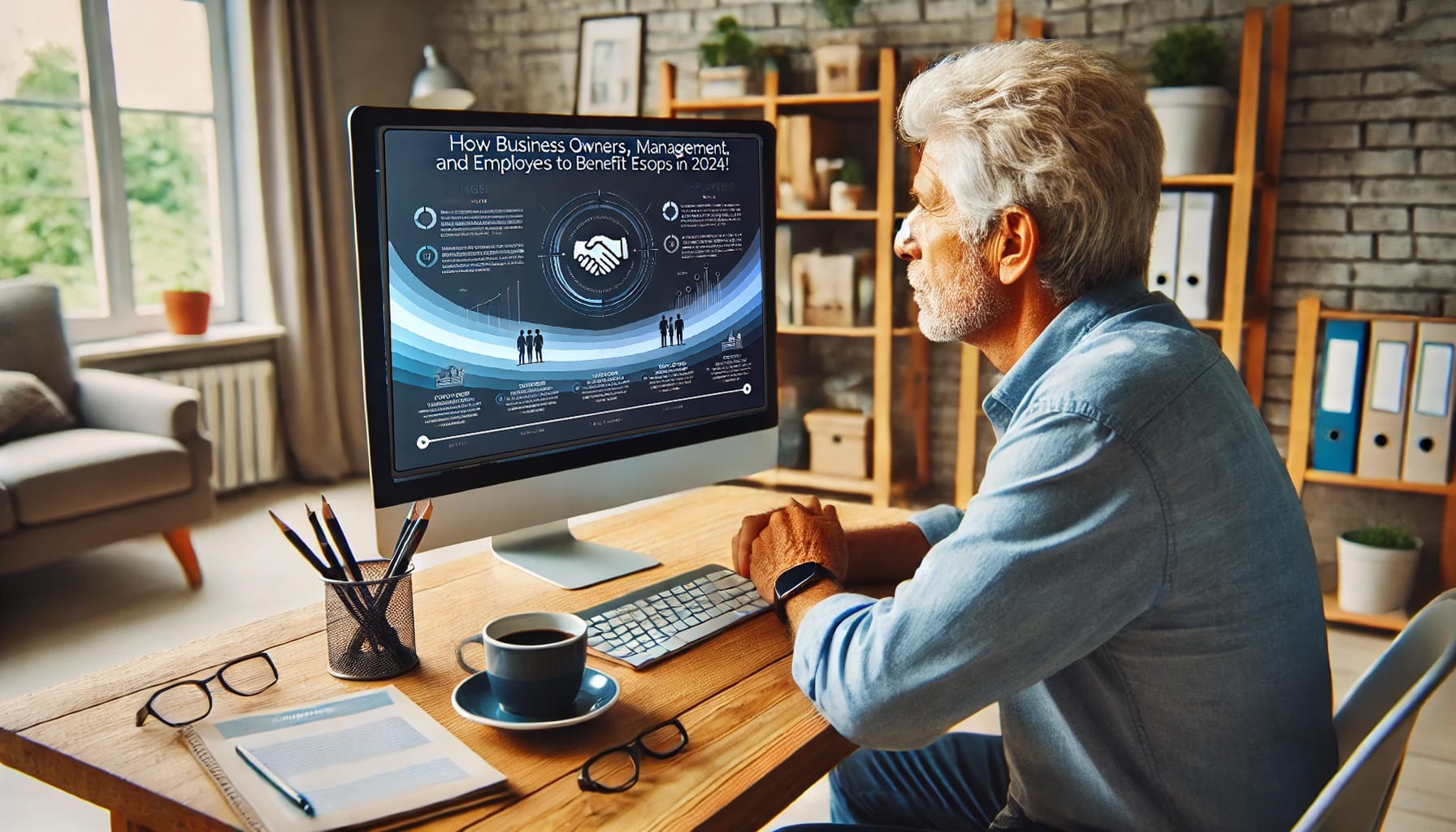
Man viewing employee stock ownership plan presentation on computer screen.
July 29, 2026
Don’t miss this opportunity to discover how ESOPs can align your business goals with the needs of employees and stakeholders.
Brass straightedge on slate, representing consistent ESOP valuation standards under new federal law
September 17, 2026
For fifty years, the hardest question in employee ownership was not how to finance the deal or how to structure the tax benefits. It was what “adequate consideration” actually meant. Congress has now answered it — and the answer is narrower, and more useful, than the headlines suggest.
Unfinished steel-frame building with a focused beam of light, representing AEC marketing and ideal client focus
September 14, 2026
Most contractors say they win work on relationships, and most are right, up to a point. What happens when the people who hold those relationships retire, or when the firm tries to grow into a market where nobody knows its name?
Abstract suspended architectural span under cable tension, representing the long-term structure of a Section 1042 tax deferral
August 31, 2026
A seller who elects Section 1042 on a $100 million ESOP transaction can defer roughly $33 million in capital gains tax, potentially for life. The same election, structured without care, can leave that seller carrying leverage on a securities portfolio for decades. The difference is in how the portfolio is built.
Abstract network of interconnected nodes representing ESOP employee ownership culture
August 17, 2026
Two companies can have identical ESOP structures on paper and produce completely different results. The difference usually comes down to three specific things — and most companies get at least one of them wrong.
Abstract image of a converging path symbolizing a 2026 ESOP market midyear review
August 3, 2026
Halfway through 2026, the ESOP market looks different than it did in January — bank lending is more competitive, private equity firms are eyeing ESOPs as an exit, and legislation is moving. Here’s what’s actually changed.