When the Next Generation Is Already in the Building
Most business owners who start thinking about an ESOP are trying to solve a specific problem: how to exit without selling to a competitor, a private equity firm, or an outside buyer who may have different plans for the business. The math, the structure, and the tax treatment matter — but so does the human question of what happens to the company after the owner steps back.
What often gets less attention is the partial ESOP — a transaction where the owner sells less than 100% of the company to the plan. This structure is not a fallback. For the right business, it is a considered choice, and it opens up options that a full sale does not.
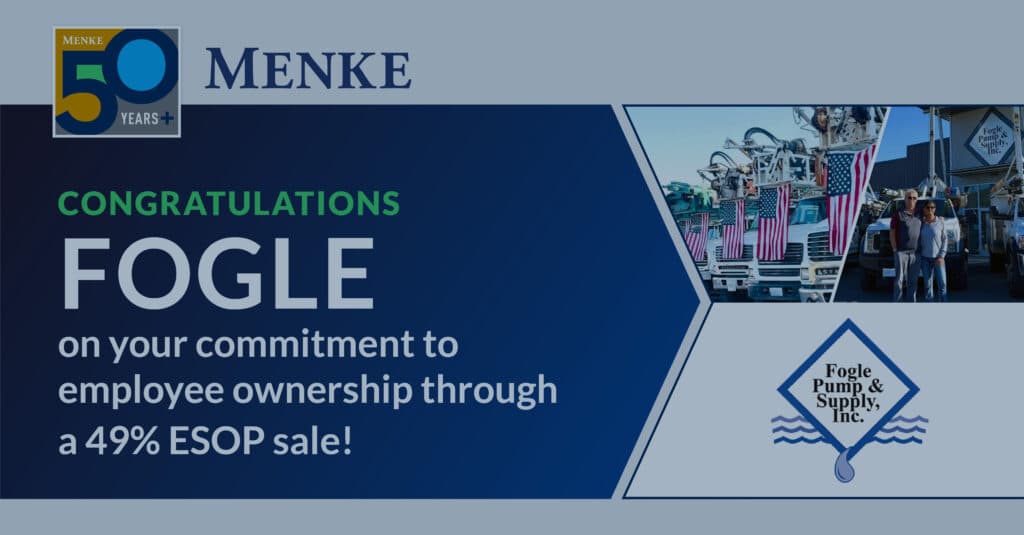
The story of Fogle Pump & Supply, Inc., a well drilling and water treatment company based in Colville, Washington, is a clear example of how a partial ESOP can be structured to fit a specific family situation — one where the owners wanted liquidity, a meaningful retirement benefit for long-term employees, and a path that kept their children in leadership without forcing a buyout.
What Fogle Pump & Supply Actually Did
Rod and Sue Fogle started the business on April 1, 1981, taking over a small pump and plumbing operation called Bargain Warehouse with no money, a newborn, and a seller who agreed to carry the contract. Over the next four-plus decades, they built the company into a 55-employee operation with four locations across northeastern Washington.
Six years ago, they first heard about ESOPs through a supplier — Preferred Pump — whose salespeople mentioned the company had converted to employee ownership. Rod Fogle reached out to Preferred Pump’s owner directly to understand what the experience looked like from a seller’s perspective. That kind of peer-to-peer diligence is common in ESOP transactions, and it matters. The Fogles eventually engaged Menke & Associates to evaluate whether an ESOP would fit their situation.
After that process, they chose a 49% sale to the ESOP trust. The reasoning was straightforward: their son Robert and daughter Alaina were already active in the business and would remain in leadership. A full sale was not the goal. The owners wanted to bring employees in as co-owners, provide a retirement benefit that would pay out when those employees eventually left, and allow Rod and Sue to begin stepping back — without handing off control entirely.
The transaction closed April 30, 2026, after six years of building up the trust. The employees are now co-owners alongside Rod, Sue, Robert, and Alaina.
What a 49% ESOP Looks Like on the Ground
A few things are worth noting about how this transaction works in practice, because they illustrate what partial ESOPs can and cannot do.
The retirement benefit works the way it typically does in an ESOP: employees accumulate shares in the trust over time, those shares are tied to the value of the company, and when an employee leaves or retires, the ESOP buys out their shares and pays them the accumulated value. This is not a profit-sharing plan or a bonus structure — it is an equity stake that builds over time and converts to cash at departure.
On the governance side, Robert and Alaina have established an executive team that includes long-term employees. That group meets to weigh in on major purchases, operational decisions, and company direction. The employees recently decided, as a group, to sponsor a local family on the television show Homestead Rescue — drilling a well at no charge — as a community goodwill and visibility effort. That kind of decision-making is one of the practical changes that comes with employee ownership: people who have a stake tend to engage differently with questions about how the company spends its time and money.
Rod is transitioning to a consulting role and plans to mostly retire starting January 2027. Sue has committed to staying through June 2027 to see the ESOP through its first full annual cycle. Neither of them is walking out the door the day after closing — which is also fairly typical. Owners who have spent decades building a business usually stay involved longer than they initially expect.
What Business Owners Should Take From This
A 49% ESOP is not the right structure for every company. It works when the owner has a reason to retain a majority — next-generation family involvement, a preference to keep control during a transition period, or a plan to sell additional shares later. It does not work as a way to delay a decision that needs to be made.
What the Fogle story illustrates is the importance of starting the process early. Six years elapsed between when Rod and Sue first heard the term “ESOP” and when they closed their transaction. That is not an unusually long timeline. ESOP planning requires feasibility analysis, legal and financial structuring, ERISA compliance, trustee engagement, and plan documentation — none of which happens quickly. Owners who want to close in two years need to start now. Owners who want to close in five years have more flexibility, but not unlimited flexibility.
If you are a business owner with employees who have been with you for a long time and you want to give them a meaningful stake in what they have helped build — while also getting liquidity and keeping your business out of outside hands — a partial ESOP is worth a serious look. It is not a simple transaction, but it is a well-established one.
Talk to Menke
Menke & Associates has been advising business owners on ESOP transactions since 1974. If you are considering whether an ESOP — partial or full — might fit your situation, contact us at menke.com or call our office to schedule a consultation. We will give you a straightforward assessment, not a sales pitch.
Source: Cami Krema, “Fogle Pump And Supply Transitions to Employee-Owned Model,” Statesman-Examiner, June 24, 2026. https://www.statesmanexaminer.com/articles/fogle-pump-and-supply-transitions-to-employee-owned-model

 Phil DeDominicis is an ESOP strategist and M&A advisor who has guided 300+ companies through ESOP formations, financing, and transactions over 20+ years at Menke & Associates. He specializes in selling ESOP‑owned businesses to financial or strategic buyers and in helping ESOP companies acquire other businesses.